
Mipro Core Reporting (MCR) is known as a solution that meets essential reporting requirements, but its development has not stopped there. We are increasingly expanding the system’s capabilities into data analytics and developing new features based on customer needs.
In this series of articles, we present the data analytics solutions being developed for MCR and demonstrate how they can provide stronger support for decision-making.
From Emissions Accounting to Continuous Improvement
Emissions accounting can be carried out as a one-off project, but the data collected during the process delivers the greatest value when emissions accounting becomes part of annual operations. Updating the calculations each year enables organisations to set emission reduction targets and monitor progress using current data incorporated into annual reporting.
Consumption data can also be monitored for purposes other than emissions accounting, even when the associated calculated emissions are not significant. Many Finnish cities participate in the Public Sector Energy Efficiency Agreement, known as JETS, which aims to reduce energy consumption by 10% from the baseline level during the 2026 to 2035 agreement period. A familiar reporting tool can be used to identify the largest energy consumers and monitor the impact of energy-saving measures.
Alongside environmental considerations, improving energy efficiency also contributes to the economic dimension of sustainability. There is a clear need for water utilities to develop their operations in a more cost-effective direction. However, process performance, such as treatment results, must also be taken into account when setting objectives. MCR is an effective tool for combining data from multiple sources. Its clear reports and charts support decision-making at management level and in day-to-day operations.
Implementing Emissions Accounting with Mipro Core Reporting
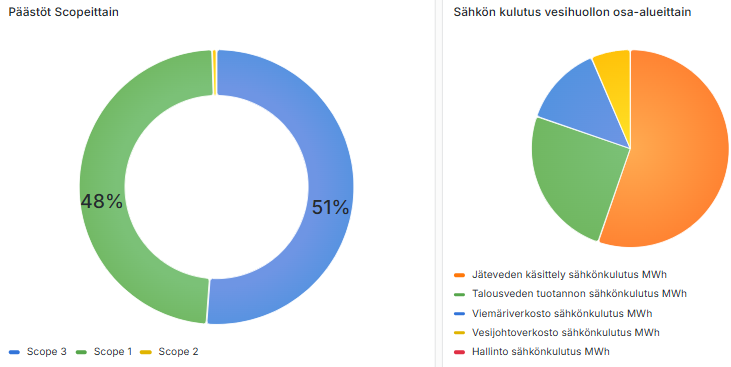
During the first phase, emissions calculations are carried out using a manual data entry form in which the operator enters the source data required for the calculations. The emission factors used in the calculations are available within the MCR solution.
The first calculation cycle can be based on the most readily available data, such as fuel consumption by the organisation’s own vehicles and the use of energy and chemicals. The scope of the calculations can be expanded gradually each year as more data becomes available and reporting practices develop.
MCR also makes it possible to combine data from multiple sources as the basis for emissions calculations. Future development will therefore focus on identifying the necessary system interfaces and automating data transfer. The aim is to reduce manual work and improve the timeliness of the data.
Continuous Monitoring Supports More Effective Decision-Making
When data is accumulated regularly in the system, emissions accounting develops from a one-off reporting exercise into a management tool. Historical data can be used to identify trends in consumption and emissions, compare results across different years and assess the impact of implemented measures.
Water utilities continuously make decisions concerning investments, process development and day-to-day operations. Reports produced in MCR can be used, for example, to support materials presented to municipal decision-makers. Reporting should also be linked to the organisation’s strategic planning if objectives relating to the reported areas have been set in the strategy of either the organisation or its owner.
When decision-making is supported by reliable and readily accessible information, improvement measures can be targeted at the areas where they will have the greatest impact. For this reason, the development of MCR focuses not only on meeting reporting obligations but also on transforming data into actionable analytics that support practical operational improvement.
Author

Eveliina Naumanen
Environmental Specialist
Eveliina has worked at Mipro for 10 years, contributing to a range of water utility projects and lifecycle services. Her responsibilities have included a broad range of sales activities. Her current role also involves integrating sustainability and sustainable development into Mipro’s VEJ business operations and contributing to Mipro’s environmental working group.